
You are spending money on clicks, watching your daily budget burn away, but your inbox remains empty. There are no new leads, no sales notifications, and no positive ROI to present to your team.
Table of Contents
Running search campaigns requires careful management. Google Ads can bring rapid results, but a single setting mistake or bad targeting choice can waste your entire budget. Understanding how paid advertising generates fast leads helps you realize that traffic alone does not equal sales. If your ads draw visitors who leave without buying, you need to fix your approach.
At Rife Media Solutions, we analyze accounts daily to uncover lost revenue. Here are the ten reasons why your Google Ads campaign is not converting and how you can fix it.
1. Targeting the Wrong Intent with Broad Match Keywords
Keyword matching determines who sees your ad. When you rely heavily on broad match keywords, Google displays your ad for search queries that are loosely related to your target terms.
For instance, if you sell high end commercial espresso machines and use broad match keywords like coffee machine, your ad might show up for searches like free coffee maker repair manual or cheap home coffee pod maker. These searchers will never buy your high end commercial equipment.
Match Types and Conversion Impact
| Match Type | Traffic Volume | Intent Level | Risk of Wasted Spend |
| Broad Match | High | Low to Variable | Very High |
| Phrase Match | Moderate | Moderate to High | Low to Moderate |
| Exact Match | Low to Moderate | High | Minimal |
To fix this, shift your strategy toward phrase match and exact match keywords. This adjustment brings visitors who are actively looking to buy your specific products or services.
2. Neglecting Your Negative Keyword List
Failing to build a negative keyword list is a fast way to burn through your ad budget. Negative keywords prevent your ads from appearing for search terms that do not lead to sales.
If you offer premium business consulting, you must add terms like the following as negative keywords:
- Free
- Cheap
- Jobs
- Careers
- DIY
- Courses
Regularly check your Search Terms Report in Google Ads. Add irrelevant search terms to your negative keyword list every week to protect your ad budget.
3. Disconnect Between Ad Copy and Landing Page
Imagine clicking an ad that promises a 30% discount on web development services, only to land on a generic homepage with no mention of discounts. You will leave immediately.
This issue is common in failing ad campaigns. Your ad copy sets an expectation, and your landing page must deliver on that promise instantly.
- Headline Match: Ensure the headline on your landing page mirrors the headline of your ad.
- Offer Consistency: Keep discounts, guarantees, and calls to action identical across both channels.
- Message Relevance: Solve the exact problem mentioned in your ad directly on the page.
Aligning your messaging improves your conversion rate and boosts your Quality Score, which lowers your cost per click.
4. Poor Landing Page Experience and Slow Load Speeds
Sending paid ad traffic to a poorly built homepage hurts your results. Homepages contain too many links, distractions, and competing options that confuse visitors.
You need dedicated landing pages designed for a single action. Additionally, page loading speed plays a major role in keeping visitors engaged.
Visitor Clicks Ad ==> Page Loads instantly ==> Clear Value Proposition ==> Single Call to Action ==> Conversion
If your page takes more than three seconds to load, potential customers will leave before reading your message. At Rife Media Solutions, our expert team builds dedicated landing pages with our specialized advertising services to convert paid clicks into actual sales.
5. Weak or Confusing Call to Action (CTA)
Visitors need clear direction on what to do next. A subtle button saying Submit or Learn More fails to motivate users.
Your call to action should communicate value directly.
- Weak CTAs: Click Here, Submit, Contact Us, Download
- Strong CTAs: Get Your Free Audit, Claim Your 20% Discount, Book Your Strategy Call, Get Instant Access
Place your CTA button above the fold so users see it without scrolling. Use contrasting colors for your button to make it stand out immediately.
6. Poor Campaign Structure and Audience Targeting
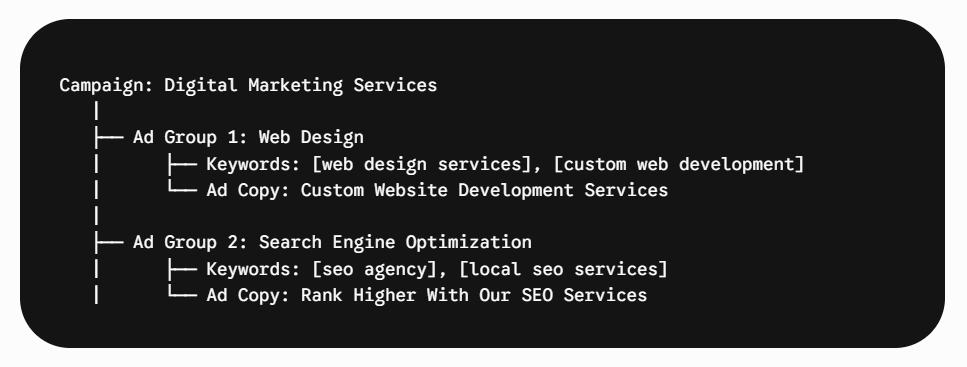
Lumping all keywords and ads into a single ad group creates confusion. If you run a digital agency offering SEO, web design, and ad management, grouping these services together leads to generic ads that miss the mark.
Instead, organize your account cleanly into specific ad groups:
Targeting the right audience on the right platform is critical. When planning your marketing strategy, evaluate Google Ads vs Meta Ads: Which is Better? to reach your customers effectively. Google Ads captures high buying intent, while Meta Ads builds awareness.
7. Tracking Setup Errors
Your Google Ads campaign might actually be generating leads, but tracking errors make it look like a failure. Incorrect tracking code setup leaves you making decisions without proper data.
Common tracking errors include:
- Counting simple page visits as completed leads.
- Failing to track form submission thank you pages.
- Ignoring phone call tracking from mobile ads.
- Double counting single conversions.
Set up Google Tag Manager to track conversion actions accurately. Without clean data, Google’s automated bidding strategies cannot optimize your account for success.
8. Misalignment with Location and Schedule Settings
Running ads during times you cannot respond to leads wastes your money. If you run a service business that takes phone calls from 9 AM to 5 PM, running ads at 2 AM usually wastes ad spend on unanswered calls.
Review your location targeting settings carefully. Google defaults to targeting People in, or who have shown interest in, your targeted locations. This setting means someone across the world searching for your local service can trigger your ad.
Change this setting to People in or regularly in your targeted locations to reach actual local customers.
9. Setting an Unrealistic Budget or Bidding Strategy
Google Ads relies on data machine learning to optimize bids. If your daily budget is too low relative to your keyword costs, Google cannot gather enough data to optimize effectively.
For example, if your target keyword costs $10 per click and your daily budget is $20, your campaign stops after just two clicks.
Low Daily Budget ==> Fewer Clicks ==> Insufficient Data ==> Failed Smart Bidding ==> Zero Conversions
Pairing limited budgets with automated bidding strategies like Target CPA creates performance issues. Start with manual CPC bidding until you collect enough conversion data, then move to automated bidding.
10. Lack of Continuous Optimization and A/B Testing
Setting up a campaign and leaving it unmanaged will cause your conversion rates to drop over time. Ad copy loses effectiveness, competitor bids shift, and market trends evolve.
Successful campaigns require continuous testing and adjustments.
Ongoing Optimization Schedule
| Tasks | Frequency | Focus Area |
| Search Term Audit | Weekly | Add negative keywords and discover new terms |
| Ad Copy A/B Testing | Bi-Weekly | Test headlines, offers, and calls to action |
| Bid & Budget Adjustments | Weekly | Reallocate funds to high performing ad groups |
| Landing Page Testing | Monthly | Test headlines, form layouts, and CTA buttons |
Regular optimization keeps your campaigns profitable and ahead of competitors.
How Rife Media Solutions Can Scale Your Campaigns
Managing Google Ads while running a business can be overwhelming. Fixing conversion issues requires technical expertise, conversion design, and data analysis.
At Rife Media Solutions, we remove the guesswork from digital marketing. Our team brings 15 years of industry experience, 2,000 completed projects, and a team dedicated to growing your business.
We take a detailed approach to paid advertising:
- Discover: We analyze your business, industry competitors, and target audience goals.
- Strategize: We build custom campaign roadmaps focused on sales, using our strategic planning services.
- Create: We write compelling ad copy and build high converting landing pages.
- Launch: We set up targeted campaigns with accurate conversion tracking.
- Optimize: We monitor performance continuously to lower costs and maximize leads.
If you struggle to turn clicks into profitable sales, knowing how to choose the best digital marketing agency for your business helps you find a team that delivers real results.
Contact Rife Media Solutions today to build campaigns that drive actual business growth.
1. How long does it take for a Google Ads campaign to start converting?
Initial conversions can happen within the first week, but full optimization takes 30 to 90 days of collecting data and refining targets.
2. What is a good conversion rate for Google Ads?
The average conversion rate across industries is roughly 3% to 5%, though high performing landing pages can achieve conversion rates of 10% or higher.
3. Why am I getting clicks on my Google Ads but zero conversions?
This issue usually stems from targeting broad keywords with low buying intent, sending traffic to an unoptimized homepage, or poor ad relevance.
4. How much daily budget do I need to see results with Google Ads?
Your daily budget should equal at least 10 times the average cost per click of your target keywords to allow proper testing and data collection.
5. Should I send my Google Ads traffic to my website homepage?
No, sending ad traffic to a homepage lowers conversion rates because homepages lack a clear, singular call to action aligned with your ad.