
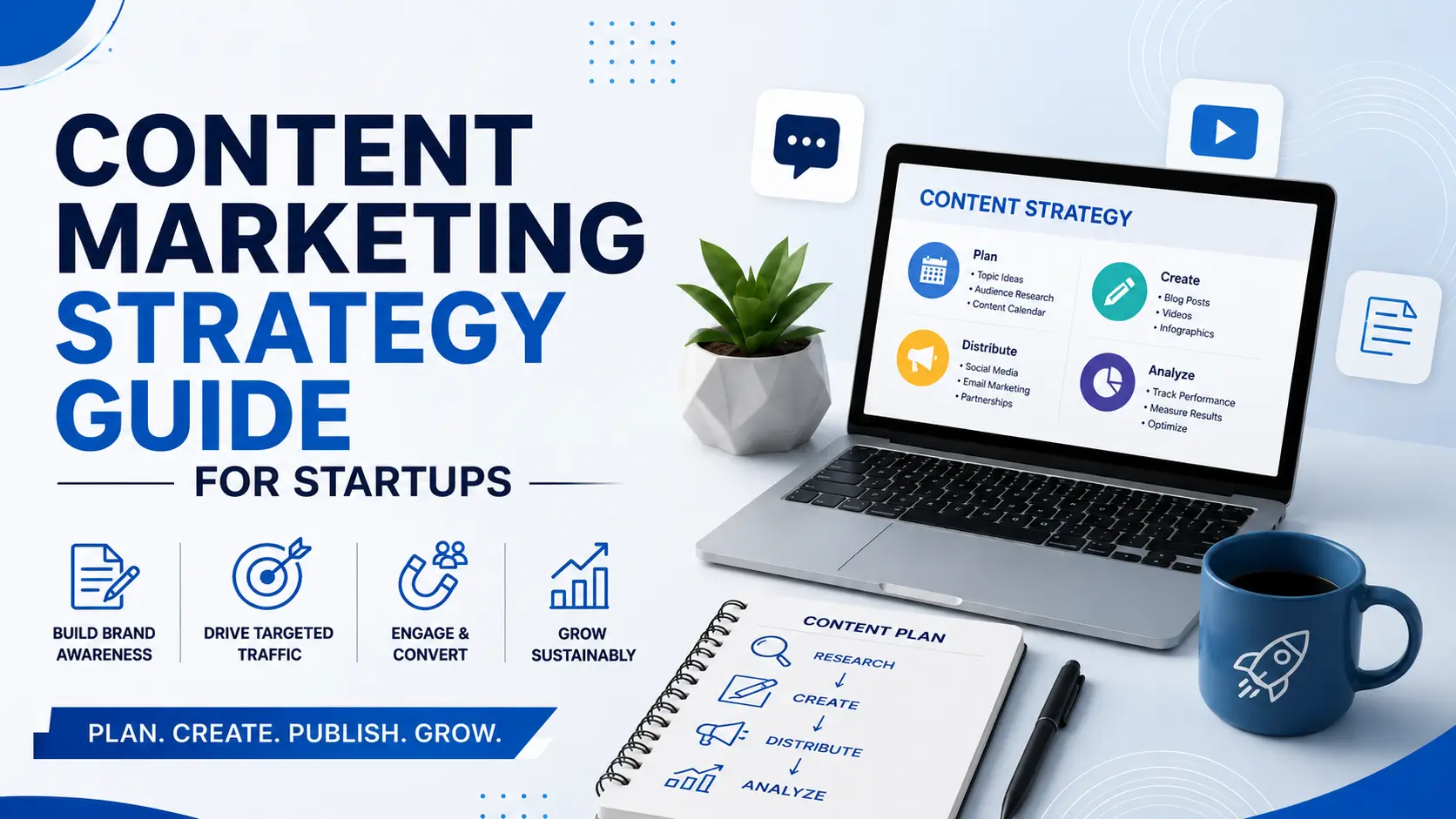
Starting a new business is an exciting journey. You have a great product or service, your team is motivated, and you are ready to change the market. However, there is a major challenge that every startup faces. How do you get people to know you exist?
Table of Contents
Traditional advertising can be incredibly expensive, and when you are just starting out, every single dollar counts. This is exactly where content marketing becomes your most valuable asset. Instead of paying massive amounts of money to push your message in front of people who might ignore it, content marketing allows you to pull people in by providing genuine value.
This comprehensive guide will walk you through building a content marketing strategy from scratch. You will learn how to identify your audience, plan your creation process, optimize your distribution, and measure your success.
What Is Content Marketing and Why Do Startups Need It?
Content marketing is the process of planning, creating, distributing, and sharing valuable material to reach your target audience. This material can include articles, videos, social media posts, podcasts, and infographics. The primary goal is not to scream at people to buy your product. Instead, the goal is to solve their problems, answer their questions, and build long term trust.
Startups need content marketing because it levels the playing field. You might not have the multi million dollar budget of an established competitor, but you can absolutely compete if your content is more helpful, more engaging, and more accurate.
The Core Benefits of Content Marketing for Startups
- It Costs Less and Returns More: Research consistently shows that content marketing costs significantly less than traditional outbound marketing while generating multiple times more leads over time.
- It Builds Sustainable Organic Traffic: An advertisement stops bringing you customers the exact moment you stop paying for it. A well written, search engine optimized article can bring you potential customers for months or even years after you publish it.
- It Establishes Your Authority: When you consistently answer the burning questions of your industry, customers start looking at your startup as an expert. This trust makes the final purchasing decision much easier for them.
- It Feeds Your Other Marketing Channels: Your social media team needs things to post. Your email marketing team needs links to send. Content marketing creates the fuel that runs your entire digital ecosystem.
At Rife Media Solutions, we specialize in helping startups navigate these initial stages. Through our Strategic Planning and Content Marketing services, we collaborate with you to build a content engine that matches your specific business goals, ensuring your startup speaks directly to the needs of your audience.
Step 1: Defining Your Target Audience and Buyer Personas
You cannot create great content if you do not know exactly who you are creating it for. A very common mistake that startups make is trying to talk to everyone. When you try to appeal to everyone, your voice becomes diluted, and you end up appealing to no one.
You need to define your target audience with absolute clarity. This requires building buyer personas, which are semi fictional profiles of your ideal customers based on real data and educated research.
How to Gather Audience Data
- Interview Your Current Customers: If you already have users, talk to them. Ask them what challenges they face, where they spend time online, and what made them trust your startup.
- Analyze Your Competitors: Look at who is engaging with your competitors on social media. What kind of questions are they asking in the comment sections? What problems are they complaining about?
- Use Social Listening Tools: Monitor industry keywords across platforms like Reddit, LinkedIn, and specialized forums to see what topics your ideal users are actively discussing.
Organizing Your Buyer Persona Data
Once you have gathered this information, you should organize it neatly so your team can refer to it whenever they sit down to create content.
| Persona Property | Description and Examples |
| Demographics | Age, location, job title, industry, and average income level. |
| Primary Goals | What are they trying to achieve in their professional or personal life? |
| Core Pain Points | What is stopping them from achieving those goals? What frustrates them daily? |
| Preferred Content Formats | Do they prefer reading detailed articles, watching short videos, or listening to podcasts? |
| Primary Channels | Where do they look for information? Is it Google, LinkedIn, YouTube, or Instagram? |
Step 2: Conducting Keyword Research and Topic Discovery
Once you know who your audience is, you need to find out exactly what they are typing into search engines. Keyword research is the backbone of Search Engine Optimization, also known as SEO. It ensures that you are not just guessing what people care about, but rather building content around verified search volume.
Understanding Search Intent
Before you pick your keywords, you must understand search intent, which is the underlying reason why a person performs a specific search. Search intent generally falls into four categories:
- Informational Intent: The user wants to learn something. For example, “how to calculate startup runway”.
- Navigational Intent: The user is trying to find a specific website or brand. For example, “Rife Media Solutions services”.
- Commercial Intent: The user is researching products or services but is not quite ready to buy yet. For example, “best CRM software for small businesses”.
- Transactional Intent: The user is ready to buy right now. For example, “buy project management software subscription”.
For a startup, focusing heavily on informational and commercial intent keywords is a great way to capture users early in their buying journey.
The Keyword Selection Matrix
When you select keywords, you need to balance search volume with keyword difficulty. As a brand new startup website, your domain authority will be low, meaning it will be very hard to rank for highly competitive keywords. You should look for long tail keywords, which are longer and more specific phrases that have lower competition but highly motivated searchers.
| Keyword Type | Definition | Example | Competition Level | Conversion Potential |
| Short Tail | Broad, one or two word phrases. | “Marketing” | Extremely High | Low |
| Middle Tail | Three word phrases with more focus. | “Content Marketing Strategy” | Medium to High | Medium |
| Long Tail | Specific phrases or complete questions. | “Content Marketing Strategy Guide for Startups” | Low to Medium | Extremely High |
Our team at Rife Media Solutions provides specialized SEO services to help startups uncover these high conversion, low competition long tail keywords. We use data and insight to make sure your brand gets found first and stays found longer on search engine result pages.
Step 3: Determining Your Content Mix and Formats
Different people absorb information in different ways. To maximize your reach, your startup should utilize a variety of content formats. However, because your resources are likely limited, you should focus on doing two or three formats exceptionally well rather than spreading yourself too thin.
Text Based Content
- Blog Posts and Articles: These are perfect for targeting educational keywords, driving organic search traffic, and explaining complex concepts in detail.
- Whitepapers and Ebooks: These are deeper, highly researched pieces of content that you can offer behind a signup form to capture email leads.
- Case Studies: These show exactly how your product or service helped a real client solve a real problem, providing powerful social proof.
Visual and Audio Content
- Short Form Video: Videos on platforms like Instagram Reels, YouTube Shorts, and TikTok are incredible for building fast brand awareness and capturing attention quickly.
- Long Form Video: Explainer videos, product tutorials, and webinars help deepen trust and show your product in action.
- Infographics: Visual breakdowns of statistics or processes are highly shareable and can help you earn back links from other websites.
If you lack the in house resources to produce high quality visuals, this is where a professional agency becomes vital. Rife Media Solutions has an elite Photography and Videography department alongside a dedicated Video Marketing team. We capture your brand in its best light and turn casual views into real business value with stunning, modern visuals.
Step 4: Structuring Your Content Creation Workflow
Consistency is the absolute secret to content marketing success. If you publish three articles in one week and then nothing for the next two months, search engines and human audiences will forget about you. To maintain a steady flow of content, you must establish a structured creation workflow.
The Content Calendar
Your content calendar is your central dashboard. It tracks every piece of content from the initial idea phase all the way to publication and distribution. Your calendar should track:
- The specific topic or headline.
- The target keyword and its search volume.
- The assigned writer or creator.
- The current production status, such as drafting, editing, or scheduled.
- The final publication date and the distribution channels.
The Five Stages of Content Production
To ensure high quality, every single piece of content you produce should pass through a standardized pipeline.
1. Discover and Research: Gathering insights.
Brainstorm ideas based on your keyword research. Gather data points, interview internal experts, and outline the core arguments of the piece.
2. Drafting: Writing the initial copy.
Write the content with a focus on solving the user problem. Keep the tone friendly, accessible, and direct. Avoid overly complex language.
3. Editing and Optimization: Refining and tuning.
Review the draft for clarity, accuracy, and grammar. Ensure your primary and secondary keywords are integrated naturally into the headings and body text.
4. Visual Design: Adding creative assets.
Create featured images, custom graphs, or short video snippets to accompany the text, breaking up large blocks of words to improve readability.
5. Launch and Publish: Going live to the world.
Upload the content to your content management system, double check the formatting on mobile devices, and hit publish.
Step 5: Content Distribution and Amplification
Publishing great content on your website is only half the battle. If you simply hit publish and wait for people to find you, you will likely be waiting a very long time. You need a proactive distribution strategy to amplify your message across the web.
There are three main distribution models that you should utilize in your strategy.
The Triple Threat Distribution Framework
| Distribution Type | Description | Key Channels for Startups |
| Owned Distribution | Channels that your startup completely controls and owns. | Your website blog, your newsletter email list, and your product dashboard. |
| Earned Distribution | Third party channels that share your content because it is valuable. | Social media shares, Reddit mentions, community forums, and public relations coverage. |
| Paid Distribution | Channels where you pay to put your content in front of a specific audience. | Google Search Ads, LinkedIn Sponsored Content, and Meta Advertising. |
The Power of Content Repurposing
Startups need to maximize efficiency. Content repurposing means taking one large piece of content and breaking it down into smaller pieces for different channels. For example, you can transform a single 1500 word blog post into:
- An informative newsletter sent directly to your email subscribers.
- A detailed carousal post for your LinkedIn page.
- A brief script for a 60 second Instagram Reel.
- An answer to a highly relevant question on Quora or Reddit.
This approach saves you massive amounts of time while expanding your footprint across multiple digital touchpoints. Our social media marketing and advertising teams at Rife Media Solutions are experts at this process. We take your core brand stories and adapt them into scroll stopping, share worthy social campaigns that amplify your visibility fast.
Step 6: Tracking, Measuring, and Optimizing Your Performance
Content marketing is a long term investment, but it is entirely data driven. You should never guess whether your strategy is working. You must track key performance indicators, also known as KPIs, to understand what resonates with your audience and what needs to be adjusted.
Critical Content Metrics to Monitor
- Traffic Metrics: Look at unique pageviews, users, and sessions. This tells you how many people are actually finding your content.
- Engagement Metrics: Track average engagement time and bounce rate. If users spend three minutes reading an article, they are finding it helpful. If they leave within five seconds, your content is not delivering on its promise.
- SEO Metrics: Monitor your organic keyword rankings, click through rates from search results, and the number of high quality external websites linking back to your domain.
- Conversion Metrics: Track newsletter signups, free trial registrations, contact form submissions, or direct product purchases originating from your content pages.
The Optimization Loop
Every month, you should review your data to uncover actionable insights. If an article is ranking on the second page of Google for a valuable keyword, update it with fresh information, better statistics, and deeper answers to push it to the first page. If a specific video format gets double the engagement of your other posts, shift your resources to produce more of that specific style.
Continuous optimization is what turns a basic blog into a powerful revenue generating asset for your business.
Partnering for Startup Growth
Building and executing a full scale content marketing strategy takes a significant amount of time, creative energy, and technical knowledge. When you are focused on building your product, managing operations, and raising capital, marketing can easily become overwhelming.
This is exactly where partnering with a creative agency can accelerate your growth. Rife Media Solutions is a creative powerhouse based in Surat, Gujarat. We blend data driven strategy with impactful storytelling to help startups build experiences that connect, engage, and convert.
We follow a proven 5 step process designed to maximize your return on investment:
- Discover: We dive deep into your brand identity, your target audience, and your business goals.
- Strategize: We design a custom content and marketing roadmap tailored specifically to your budget and market opportunities.
- Create: Our copywriters, web developers, designers, and videographers bring bold ideas to life with modern flair.
- Launch: We execute your campaign across search, social, and paid channels with absolute precision.
- Optimize: We constantly measure, tweak, and refine your campaigns to maximize your visibility and performance.
Whether you need a stunning, high performance web design, search engine optimization that ranks you first, scroll stopping social media marketing, or comprehensive content strategy planning, we have the tools and expertise to make your startup stand out from the crowd.
Are you ready to take the next step and turn your startup into an industry authority? Let us collaborate to build something great together.
Frequently Asked Questions
1. What is content marketing and why does my startup need it?
Content marketing is sharing helpful information like articles and videos to attract customers without forcing a sales pitch. It helps startups build trust and get found online without spending a fortune on traditional ads.
2. How long does it take to see results from content marketing?
Content marketing is a long term strategy that usually takes six to nine months to show significant results. However, the articles and videos you create now will continue to bring you traffic and customers for years to come.
3. How do I know what topics my customers care about?
You can find topics by talking directly to your current clients and checking the questions people ask on social media. Using online search tools to see what words people type into Google will also tell you exactly what they need help with.
4. Can a startup do content marketing with a very small team?
Yes, a small team can succeed by focusing on just one or two content types, like blog posts or short videos, instead of trying to do everything. You can also save time by breaking one large article down into multiple smaller social media posts.
5. How can Rife Media Solutions help my startup with content marketing?
Rife Media Solutions takes the hard work off your hands by creating custom plans, writing articles, and making professional videos for your business. Our experienced team handles everything from research to promotion so you can focus entirely on growing your startup.